Quadratic equations have the form $latex ax^2+bx+c$. Depending on the type of quadratic equation we have, we can use various methods to solve it. Some of the most important methods are methods for incomplete quadratic equations, the factoring method, the method of completing the square, and the quadratic formula.
Here, we will look at a brief summary of solving quadratic equations. Then, we will look at 20 quadratic equation examples with answers to master the various methods of solving these typesof equations.
Summary of quadratic equations
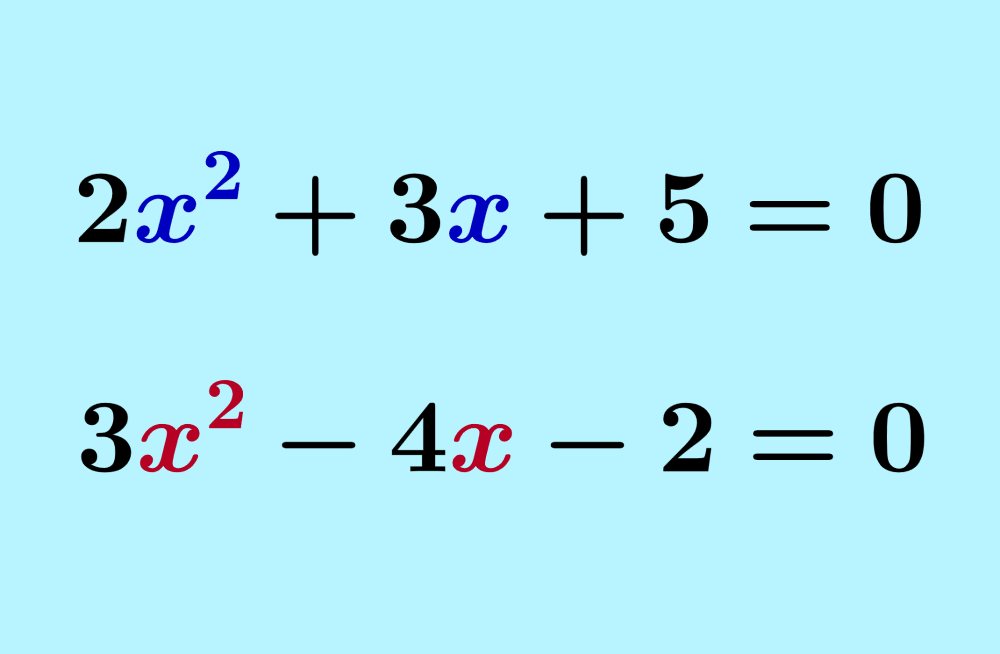
Recall that quadratic equations are equations in which the variables have a maximum power of 2. These equations have the general form $latex ax^2+bx+c=0$. For example, the equations $latex 4x^2+x+2=0$ and $latex 2x^2-2x-3=0$ are quadratic equations.
There are several methods that we can use to solve quadratic equations depending on the type of equation we have. The most common methods are by factoring, completing the square, and using the quadratic formula.
We can solve incomplete quadratic equations of the form $latex ax^2+c=0$ by completely isolating x². Then we can take the square root of both sides of the equation.
To solve incomplete quadratic equations of the form $latex ax^2+bx=0$, we have to factor x from both terms. Then, we can form an equation with each factor and solve them.
When we have complete quadratic equations of the form $latex ax^2+bx+c=0$, we can use factorization and write the equation in the form $latex (x+p)(x+q)=0$ which will allow us to find its roots easily.
Finally, when it is not possible to solve a quadratic equation with factorization, we can use the general quadratic formula:
$$x=\frac{-b\pm \sqrt{b^2-4ac}}{2a}$$
You can learn or review the methods for solving quadratic equations by visiting our article: Solving Quadratic Equations - Methods and Examples.
20 quadratic equation examples with answers
The following 20 quadratic equation examples have their respective solutions using different methods. Try to solve the problems yourself before looking at the solution.
EXAMPLE 1
Find the solutions to the equation $latex x^2-25=0$.
Solution
This equation is an incomplete quadratic equation that does not have the bx term. We can solve this equation by isolating the x² term and taking the square root of both sides of the equation:
$latex x^2-25=0$
$latex x^2=25$
Taking the square root of both sides, we have:
$latex x=\pm \sqrt{25}$
$latex x=\pm 5$
The solutions to the equation are $latex x=5$ and $latex x=-5$.
EXAMPLE 2
What are the solutions to the equation $latex x^2-4x=0$?
Solution
This is an incomplete quadratic equation that does not have the c term. To solve this equation, we need to factor x and then form an equation with each factor:
$latex x^2-4x=0$
$latex x(x-4)=0$
Forming an equation with each factor, we have:
$latex x=0~~$ or $latex ~~x-4=0$
$latex x=0~~$ or $latex ~~x=4$
The solutions of the equation are $latex x=0$ and $latex x=4$.
EXAMPLE 3
Solve the equation $latex x^2+5x+6=0$.
Solution
We can solve this equation using the factoring method. For this, we look for two numbers that when multiplied are equal to 6 and when added are equal to 5.
The two numbers we are looking for are 2 and 3. Therefore, we have:
$latex x^2+5x+6=0$
$latex (x+2)(x+3)=0$
Now, we form an equation with each factor and solve:
$latex x+2=0~~$ or $latex ~~x+3=0$
$latex x=-2~~$ or $latex ~~x=-3$
The solutions to the equation are $latex x=-2$ and $latex x=-3$.
EXAMPLE 4
What are the roots to the equation $latex x^2-6x-7=0$?
Solution
We can solve this equation by factoring. For this, we look for two numbers, which when multiplied are equal to -7 and when added are equal to -6.
The numbers we are looking for are -7 and 1. Therefore, we have:
$latex x^2-6x-7=0$
$latex (x-7)(x+1)=0$
Forming an equation with each factor, we have:
$latex x-7=0~~$ or $latex ~~x+1=0$
$latex x=7~~$ or $latex ~~x=-1$
The solutions to the equation are $latex x=7$ and $latex x=-1$.
EXAMPLE 5
Solve the equation $latex 2x^2-32=0$.
Solution
This equation is an incomplete quadratic equation of the form $latex ax^2+c=0$. We can solve this equation by solving for x² and taking the square root of both sides:
$latex 2x^2-32=0$
$latex 2x^2=32$
$latex x^2=16$
Taking the square root of both sides, we have:
$latex x=\pm \sqrt{16}$
$latex x=\pm 4$
The solutions of the equation are $latex x=4$ and $latex x=-4$.
EXAMPLE 6
Find the roots to the equation $latex 4x^2+8x=0$.
Solution
This equation is an incomplete quadratic equation of the form $latex ax^2+bx=0$. To solve this equation, we can factor 4x from both terms and then form an equation with each factor:
$latex 4x^2+8x=0$
$latex 4x(x+2)=0$
Forming an equation with each factor, we have:
$latex 4x=0~~$ or $latex ~~x+2=0$
$latex x=0~~$ or $latex ~~x=-2$
The solutions to the equation are $latex x=0$ and $latex x=-2$.
EXAMPLE 7
Find the solutions to the equation $latex x^2+4x-6=0$ using the method of completing the square.
Solution
To complete the square, we take the coefficient b, divide it by 2, and square it. Then, we have:
$$\left(\frac{b}{2}\right)^2=\left(\frac{4}{2}\right)^2$$
$$=2^2$$
Now, we add and subtract that value to the quadratic equation:
$$x^2+4x-6=x^2+4x+2^2-2^2-6$$
Now, we can complete the square and simplify:
$latex = (x+2)^2-4-6$
$latex = (x+2)^2-10$
Thus, we have the equation:
$latex (x+2)^2=10$
Taking the square root of both sides, we have:
⇒ $latex x+2=\sqrt{10}$
Solving, we have:
⇒ $latex x=-2\pm \sqrt{10}$
EXAMPLE 8
Find the solutions of the equation $latex x^2-8x+4=0$ to two decimal places.
Solution
We can identify the coefficients $latex a=1$, $latex b=-8$, and $latex c=4$. Using these values in the quadratic formula, we have:
$$x=\frac{-b\pm \sqrt{b^2-4ac}}{2a}$$
$$x=\frac{-(-8)\pm \sqrt{( -8)^2-4(1)(4)}}{2(1)}$$
$$=\frac{8\pm \sqrt{64-16}}{2}$$
$$=\frac{8\pm \sqrt{48}}{2}$$
$$x=7.46 \text{ or } 0.54$$
The solutions are $latex x=7.46$ and $latex x=0.54$.
EXAMPLE 9
Solve the equation $latex 2x^2+8x-10=0$ using the method of completing the square.
Solution
We can divide the entire equation by 2 to make the coefficient of the quadratic term equal to 1:
⇒ $latex x^2+4x-5=0$
Now, we take the coefficient b, divide it by 2 and square it. Therefore, we have:
$$\left(\frac{b}{2}\right)^2=\left(\frac{4}{2}\right)^2$$
$$=2^2$$
Adding and subtracting that value to the quadratic expression, we have:
$$x^2+4x-5=x^2+4x+2^2-2^2-5$$
Completing the square and simplifying, we have:
$latex = (x+2)^2-4-5$
$latex = (x+2)^2-9$
Now, we write the equation like this:
⇒ $latex (x+2)^2=9$
And we take the square root of both sides:
⇒ $latex x+2=\pm 3$
Solving, we have:
⇒ $latex x=1$ or $latex x=-5$
EXAMPLE 10
Use the quadratic formula to solve the equation $latex x^2-10x+25=0$.
Solution
We can identify the coefficients $latex a=1$, $latex b=-10$, and $latex c=25$. Using them in the general quadratic formula, we have:
$$x=\frac{-b\pm \sqrt{b^2-4ac}}{2a}$$
$$x=\frac{-(-10)\pm \sqrt{( -10)^2-4(1)(25)}}{2(1)}$$
$$=\frac{10\pm \sqrt{100-100}}{2}$$
$$=\frac{10\pm \sqrt{0}}{2}$$
$$=\frac{10}{2}$$
$latex x=5$
In this case, we have a single repeated root $latex x=5$.
EXAMPLE 11
Find the roots of the equation $latex 4x^2+5=2x^2+20$.
Solution
First, we need to simplify this equation and write it in the form $latex ax^2+bx+c=0$:
$latex 4x^2+5=2x^2+20$
$latex 4x^2-2x^2+5-20=0$
$latex 2x^2-15=0$
Now, we can see that it is an incomplete quadratic equation that does not have the bx term. Therefore, we can solve it by solving for x² and taking the square root of both sides:
$latex 2x^2-15=0$
$latex 2x^2=15$
$latex x^2=\frac{15}{2}$
$latex x=\pm \sqrt{\frac{15}{2}}$
EXAMPLE 12
Solve the equation $latex 5x^2+5x=2x^2+10x$.
Solution
To solve the equation, we have to start by writing it in the form $latex ax^2+bx+c=0$. Therefore, we have:
$latex 5x^2+5x=2x^2+10x$
$latex 5x^2-2x^2+5x-10x=0$
$latex 3x^2-5x=0$
We see that it is an incomplete equation that does not have the term c. Thus, we can solve it by factoring x:
$latex 3x^2-5x=0$
$latex x(3x-5)=0$
$latex x=0~~$ or $latex ~~3x-5=0$
$latex x=0~~$ or $latex ~~x=\frac{5}{3}$
EXAMPLE 13
Solve the equation $latex 3x^2+5x-4=x^2-2x$ using the general quadratic formula. Express the solutions to two decimal places.
Solution
To use the general formula, we have to start by writing the equation in the form $latex ax^2+bx+c=0$:
$latex 3x^2+5x-4=x^2-2x$
$latex 2x^2+7x-4=0$
Now, we have the coefficients $latex a=2$, $latex b=7$, and $latex c=-4$. Therefore, using these values in the quadratic formula, we have:
$$x=\frac{-b\pm \sqrt{b^2-4ac}}{2a}$$
$$x=\frac{-(7)\pm \sqrt{( 7)^2-4(2)(-4)}}{2(2)}$$
$$=\frac{-7\pm \sqrt{49+32}}{4}$$
$$=\frac{-7\pm \sqrt{81}}{2}$$
$$=\frac{-7\pm 9}{2}$$
$$=-8 \text{ or }1$$
The solutions of the equation are $latex x=-8$ and $latex x=1$.
EXAMPLE 14
Solve the following equation $$(3x+1)(2x-1)-(x+2)^2=5$$
Solution
To solve this equation, we need to expand the parentheses and simplify to the form $latex ax^2+bx+c=0$. Therefore, we have:
$$(3x+1)(2x-1)-(x+2)^2=5$$
$$6x^2-x-1-(x^2+4x+4)=5$$
$latex 5x^2-5x-5=5$
$latex 5x^2-5x-10=0$
Now, we can solve by factorization:
$latex 5x^2-5x-10=0$
$latex 5(x^2-x-2)=0$
$latex 5(x+1)(x-2)=0$
$latex x+1=0~~$ or $latex ~~x-2=0$
$latex x=-1~~$ or $latex ~~x=2$
EXAMPLE 15
Use the method of completing the square to solve the equation $latex -x^2+3x+1=-2x^2+6x$.
Solution
We have to start by writing the equation in the form $latex ax^2+bx+c=0$:
$latex -x^2+3x+1=-2x^2+6x$
$latex x^2-3x+1=0$
Now, we see that the coefficient b in this equation is equal to -3. Therefore, we have:
$$\left(\frac{b}{2}\right)^2=\left(\frac{-3}{2}\right)^2$$
Adding and subtracting this value to the quadratic equation, we have:
$$x^2-3x+1=x^2-2x+\left(\frac{-3}{2}\right)^2-\left(\frac{-3}{2}\right)^2+1$$
Completing the square and simplifying, we have:
$latex = (x-\frac{3}{2})^2-\left(\frac{-3}{2}\right)^2+1$
$latex = (x-\frac{3}{2})^2-\frac{5}{4}$
Now, we write the equation as follows:
$latex ⇒ (x-\frac{3}{2})^2=\frac{5}{4}$
Taking the square root of both sides, we have:
⇒ $latex x-\frac{3}{2}=\sqrt{\frac{5}{4}}$
⇒ $latex x-\frac{3}{2}=\frac{\sqrt{5}}{2}$
Solving, we have:
⇒ $latex x=\frac{3}{2}\pm \frac{\sqrt{5}}{2}$
EXAMPLE 16
Prove that the equation $latex 5x^2+4x+10=0$ has no real solutions using the general formula.
Solution
We can use the values $latex a=5$, $latex b=4$, and $latex c=10$ in the quadratic formula:
$$x=\frac{-b\pm \sqrt{b^2-4ac}}{2a}$$
$$x=\frac{-(4)\pm \sqrt{( 4)^2-4(5)(10)}}{2(5)}$$
$$=\frac{-5\pm \sqrt{16-200}}{10}$$
$$=\frac{-5\pm \sqrt{-184}}{10}$$
We can see that we got a negative number inside the square root. $latex \sqrt{-184}$ is not a real number, so the equation has no real roots.
→ Quadratic Equations Calculator
EXAMPLE 17
Solve the following equation $$\frac{4}{x-1}+\frac{3}{x}=3$$
Solution
This equation does not appear to be quadratic at first glance. However, we can multiply it by $latex x(x-1)$ to eliminate the fractions, and we have:
$$\frac{4}{x-1}+\frac{3}{x}=3$$
$$4x+3(x-1)=3x(x-1)$$
$$4x+3x-3=3x^2-3x$$
$latex 3x^2-10x+3=0$
Now, we can factor this equation to solve it:
$latex 3x^2-10x+3=0$
$latex (3x-1)(x-3)=0$
$latex 3x-1=0~~$ or $latex ~~x-3=0$
$latex x=\frac{1}{3}~~$ or $latex ~~x=3$
EXAMPLE 18
Find the solutions to the following equation $$\frac{2x+1}{x+5}=\frac{3x-1}{x+7}$$
Solution
To simplify fractions, we can cross multiply to get:
$$ (2x+1)(x+7)=(3x-1)(x+5)$$
Expanding and simplifying, we have:
$$ 2x^2+15x+7=3x^2+14x-5 $$
$latex x^2-x-12=0$
Factoring and solving, we have:
$latex (x+3)(x-4)=0$
$latex x+3=0~~$ or $latex ~~x-4=0$
$latex x=-3~~$ or $latex ~~x=4$
EXAMPLE 19
Find two numbers such that their sum equals 17 and their product equals 60.
Solution
To solve this problem, we can form equations using the information in the statement. We use the letters X (smaller number) and Y (larger number) to represent the numbers:
$latex X+Y=17~~[1]$
$latex XY=60~~[2]$
Writing equation 1 as $latex Y=17-X$ and substituting it into the second equation, we have:
$latex X(17-X)=60$
We can expand and write it in the form $latex ax^2+bx+c=0$:
$latex 17X-X^2=60$
$latex X^2-17X+60=0$
Now, we can solve the equation by factoring:
$latex X^2-17X+60=0$
$latex (X-12)(X-5)=0$
$latex X-12=0~~$ or $latex ~~X-5=0$
$latex X=12~~$ or $latex ~~X=5$
Therefore, we have:
- If $latex X=5$, we have $latex Y=17-5=12$. This solution is the correct one because X<Y.
- If $latex X=12$, we have $latex Y=17-12=5$
The numbers are 12 and 5.
EXAMPLE 20
If the area of a rectangle is 78 square units and its longest side is 7 units longer than its shortest side, what are the lengths of the sides?
Solution
To solve this problem, we have to use the given information to form equations. Let's represent the shorter side with x. This means that the longest side is equal to x+7.
Now considering that the area of a rectangle is found by multiplying the lengths of its sides, we have:
$latex x(x+7)=78$
Expanding and writing the equation in the form $latex ax^2+bx+c=0$, we have:
$latex x^2+7x-78=0$
Solving by factorization, we have:
$latex (x+13)(x-6)=0$
$latex x+13=0~~$ or $latex ~~x-6=0$
$latex x=-13~~$ or $latex ~~x=6$
Since we can't have negative lengths, we have $latex x=6$, so the lengths are 6 and 13.
See also
Interested in learning more about quadratic equations? Take a look at these pages: