The power rule is one of the most used formulas in Differential Calculus. This rule is applied to solve derivatives of functions with a single term. The power rule allows us to calculate derivatives easily since we do not have to use the formula for a derivative with limits.
Here, we will learn how to find derivatives of functions that have only one term. We will explore the formula that we can use and apply it to solve some practice problems.
- The Power Rule and its formula
- Special cases and forms of the Power Rule formula
- Proofs of The Power Rule
- When to use the Power Rule formula
- How to use the Power Rule to find derivatives, a step by step tutorial
- Power Rule – Examples with answers
- Power Rule – Practice problems
- See also
- Definition and formula of the power rule of derivatives
- Steps to use the power rule of derivatives
- Examples of the power rule of derivatives
- Power rule of derivatives - Practice problems
- See also
Definition and formula of the power rule of derivatives
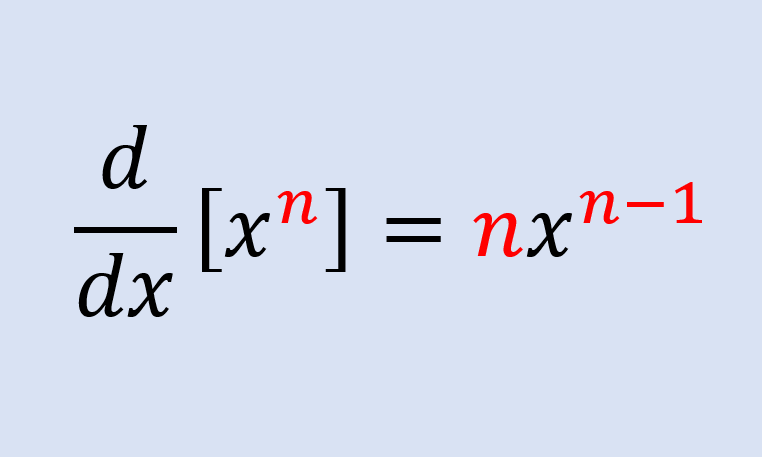
The power rule of derivatives tells us that the derivative of a variable raised to a numerical exponent is equal to the value of the numerical exponent multiplied by the variable raised to the amount of the numerical exponent subtracted by one.
The power rule allows us to obtain derivatives of functions with numerical exponents without the need to use the formula for a derivative with limits.
Other forms and cases of the power rule also exist, such as the case of polynomials, but they will be explored when we learn the applicable derivative rules.
Formula for the power rule of derivatives
The formula for the power rule is:
| $$\frac{d}{dx}(x^n) = nx^{n-1}$$ |
where
- $latex n =$ the numerical value of the exponent limited only to real numbers
- $latex x =$ the variable that is raised to a numerical exponent $latex n$
We can also denote $latex \frac{d}{dx}(x^n)$ with $latex y'$, $latex F'(x)$, $latex f'(x)$, or other letters used to denote functions with the apostrophe symbol.
Steps to use the power rule of derivatives
Suppose we have to derive
$latex f(x) = x^2$
We have a function with a variable raised to a power of 2. To derive this problem, we are going to use the power rule as shown in the following steps:
Step 1: We start by writing the formula for the power rule:
$latex f'(x^n) = nx^{n-1}$
Step 2: If the function contains either radicals or rational expressions, we use the laws of exponents to convert them to exponential form. In this case, we have no radicals or rational expressions.
Note: An example would be to write $latex \sqrt{x}$ as $latex x^{\frac{1}{2}}$.
Step 3: Determine the exponent of the variable. In this case, our exponent is 2. Therefore,
$latex n = 2$
Step 4: Apply the power rule formula to derive the problem:
$$\frac{d}{dx} (x^n) = \frac{d}{dx} (x^2)$$
$$\frac{d}{dx} (x^2) = 2 \cdot x^{2-1}$$
Step 5: Simplify the resulting expression:
$$\frac{d}{dx} (x^2) = 2x^{1}$$
$$f'(x) = 2x$$
You can use $latex f'(x), y',$ or $latex \frac{d}{dx}(f(x))$ as the derivative symbol on the left-hand side of the final answer instead of $latex ( x^n)'$ or $latex \frac{d}{dx}(x^n)$.
Examples of the power rule of derivatives
Each of the following examples has its respective detailed solution, where we apply the power rule of derivatives.
EXAMPLE 1
Find the derivative of $latex f(x)=x^3$.
Solution
Step 1: We start with the formula:
$latex f'(x^n) = nx^{n-1}$
Step 2: The expression has a numerical exponent, so we can skip this step.
Step 3: In this case, the exponent is 3. Thus,
$latex n = 3$
Step 4: Using the power rule, we have:
$$\frac{d}{dx} (x^n) = \frac{d}{dx} (x^3)$$
$$\frac{d}{dx} (x^3) = 3 \cdot x^{3-1}$$
Step 5: Simplifying, we have:
$$\frac{d}{dx} (x^3) = 3 x^2$$
$$f'(x)= 3 x^2$$
EXAMPLE 2
Find the derivative of the function $latex f(x)=5x^4$.
Solution
Step 1: We have the formula:
$latex f'(x^n) = nx^{n-1}$
Step 2: The exponent of the variable is an integer, so we can skip this step.
Step 3: In this case, the exponent is 4. Therefore,
$latex n = 4$
Step 4: Applying the power rule, we have:
$$\frac{d}{dx} (x^n) = \frac{d}{dx} (5x^4)$$
$$\frac{d}{dx} (5x^4) = 4 \cdot (5x^{4-1})$$
Step 5: Simplifying, we have:
$$\frac{d}{dx} (5x^4) = 20 x^3$$
$$f'(x)= 20 x^3$$
EXAMPLE 3
Determine the derivative of the function $latex f(x)=10x^7$.
Solution
Step 1: The formula for the power rule of derivatives is:
$latex f'(x^n) = nx^{n-1}$
Step 2: The expression has a numerical exponent, so we don't have to apply this step.
Step 3: The exponent of the expression is 7. Thus, we have:
$latex n = 7$
Step 4: When we apply the power rule, we have:
$$\frac{d}{dx} (x^n) = \frac{d}{dx} (10x^7)$$
$$\frac{d}{dx} (10x^7) = 7 \cdot (10x^{7-1})$$
Step 5: Simplifying, we have:
$$\frac{d}{dx} (10x^7) = 70 x^6$$
$$f'(x)= 70 x^6$$
EXAMPLE 4
Derive the function: $latex f(x) = -12x^{-13}$.
Solution
Step 1: We have the formula:
$latex f'(x^n) = nx^{n-1}$
Step 2: The expression is given in exponential form, so we can skip this step.
Step 3: Determine the exponent of the variable. In this case, our exponent is -13. Then,
$latex n = -13$
Step 4: We derive using the power rule:
$$\frac{d}{dx} (x^n) = \frac{d}{dx} (-12x^{-13})$$
$$\frac{d}{dx} (-12x^{-13}) = -13 \cdot (-12 x^{-13-1})$$
Step 5: Simplifying, we have:
$$\frac{d}{dx} (-12x^{-13}) = 156x^{-14}$$
Since the exponent is negative, we can apply the laws of exponents to further simplify it rationally, although this is optional:
$$\frac{d}{dx} (x^n) = \frac{156}{x^{14}}$$
The final answer is:
$$f'(x) = \frac{156}{x^{14}}$$
EXAMPLE 5
Find the derivative of $latex f(x)=\sqrt{x}$.
Solution
Step 1: We start with the power rule formula:
$latex f'(x^n) = nx^{n-1}$
Step 2: We have to use the rule of radical exponents to rewrite the expression:
$$ \sqrt{x}=x^{\frac{1}{2}}$$
Step 3: Now, we see that the exponent is 1/2. Then,
$latex n = \frac{1}{2}$
Step 4: Using the power rule in the function, we have:
$$\frac{d}{dx} (x^n) = \frac{d}{dx} (x^{\frac{1}{2}})$$
$$\frac{d}{dx} (x^{\frac{1}{2}}) = \frac{1}{2} \cdot ( x^{\frac{1}{2}-1})$$
Step 5: Simplifying, we have:
$$f'(x) = \frac{1}{2} x^{-\frac{1}{2}}$$
We can use the rules of exponents to write as follows:
$$f'(x) = \frac{1}{2x^{\frac{1}{2}}}$$
$$f'(x) = \frac{1}{2\sqrt{x}}$$
EXAMPLE 6
Find the derivative of $latex f(x)=\frac{1}{\sqrt{x}}$.
Solution
Step 1: The power rule formula is:
$latex f'(x^n) = nx^{n-1}$
Step 2: Using the rules of exponents, we can write as follows:
$$ \frac{1}{\sqrt{x}}=x^{-\frac{1}{2}}$$
Step 3: The exponent of the expression is -1/2. Thus, we have:
$latex n = -\frac{1}{2}$
Step 4: Applying the power rule on the function, we have:
$$\frac{d}{dx} (x^n) = \frac{d}{dx} (x^{-\frac{1}{2}})$$
$$\frac{d}{dx} (x^{-\frac{1}{2}}) = -\frac{1}{2} \cdot ( x^{-\frac{1}{2}-1})$$
Step 5: Simplifying, we have:
$$f'(x) = -\frac{1}{2} x^{-\frac{3}{2}}$$
We use the rules of exponents to write as follows:
$$f'(x) = -\frac{1}{2x^{\frac{3}{2}}}$$
$$f'(x) = -\frac{1}{2\sqrt{x^3}}$$
Power rule of derivatives - Practice problems
Use the power rule to find the derivatives of the following functions.
See also
Interested in learning more about derivatives of functions? You can take a look at these pages: